


.jpg?x-oss-process=image/resize,w_100/quality,q_100)

.jpg?x-oss-process=image/resize,w_100/quality,q_100)
.jpg?x-oss-process=image/resize,w_100/quality,q_100)
How to Choose the Right Pixel Pitch for a Stadium LED Screen
Sep 29, 2026
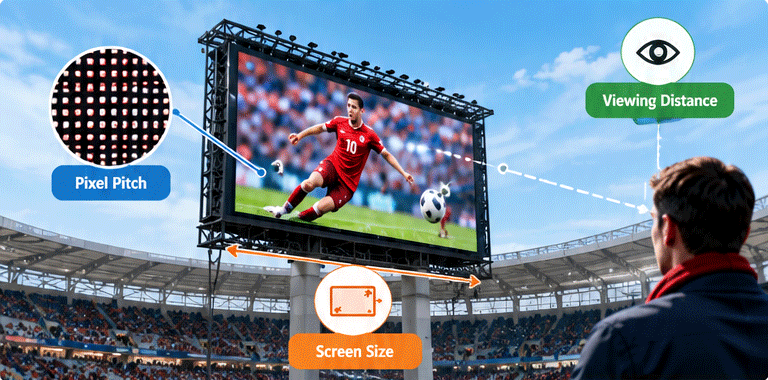
Choosing the right pixel pitch is one of the most important decisions when planning a large stadium LED screen. A finer pixel pitch increases pixel density and supports closer viewing, but it also increases the amount of LED hardware required across the entire display.For a large outdoor LED display, the question is not simply how much resolution can be achieved. The more practical question is how much resolution the audience can actually see at the intended viewing distance.
Three factors should be considered together: pixel pitch, viewing distance and screen size.
Start With Viewing Distance: How to Choose the Right Pixel Pitch
Pixel pitch is the distance between the centers of two adjacent LED pixels. A smaller pixel pitch places more pixels into the same area, producing higher pixel density and allowing viewers to stand closer to the screen before individual pixels become noticeable.
For an LED screen viewing distance analysis, the closest meaningful viewing position is the most useful starting point.
| Pixel Pitch | Approx. Planning Distance | Typical Consideration |
| P2.5 | 6–8 m | Near-field applications |
| P3.9 | 10–12 m | Events / closer viewing |
| P4.8 | 12–15 m | Large outdoor displays |
| P6 | 15–18 m | Stadium-scale applications |
| P8–P10 | 20–30 m+ | Long-distance viewing |
*Indicative planning ranges only. Actual selection depends on viewing geometry, content, brightness, camera requirements and display design.The relationship is straightforward. When viewers are close to the display, a finer pitch reduces visible pixel structure. When viewers are farther away, a larger pitch can often provide sufficient image detail.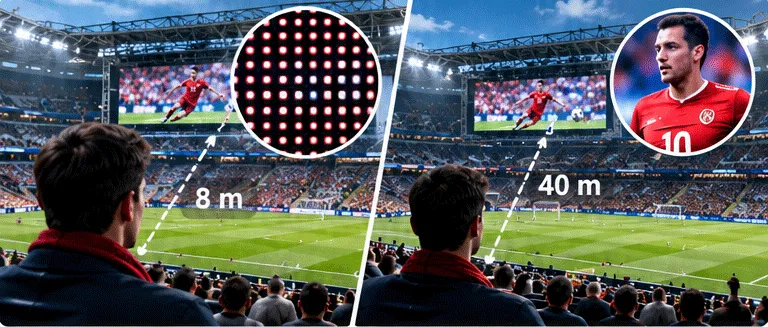
For example, a P6 outdoor LED display viewed from 40 meters has a very different visual requirement from the same display viewed from 8 meters. At 40 meters, individual pixels are much harder to distinguish. At 8 meters, the pixel structure becomes more apparent.This is why LED screen viewing distance should be established before selecting a pixel pitch.
How Screen Size Affects Pixel Density and Project Cost
Viewing distance determines how much detail the audience needs. Screen size determines how many pixels the project has to purchase to deliver that detail.
Pixel density increases rapidly as pixel pitch decreases:
Pixel Density ≈ 1,000,000 ÷ Pixel Pitch²
For example:
- P8: approximately 15,625 pixels/m²
- P6: approximately 27,778 pixels/m²
- P4.8: approximately 43,403 pixels/m²
The difference becomes substantial on a large screen.A 200 m² screen at P8 contains roughly 3.13 million pixels. The same 200 m² screen at P6 contains approximately 5.56 million pixels.
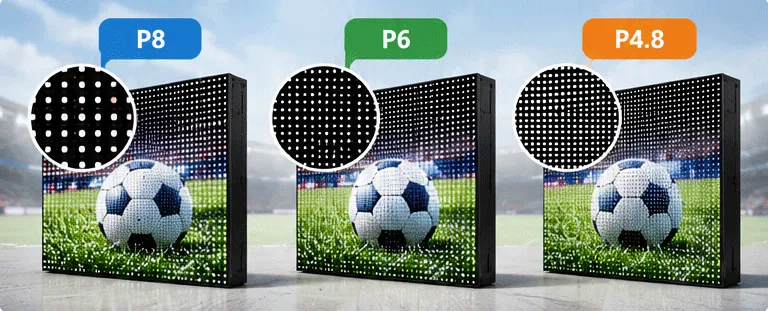
The physical screen has not changed. The number of pixels has.This affects the amount of LED components, receiving cards and processing capacity required. It can also influence power consumption, spare parts and maintenance requirements.For a large outdoor LED video wall, these differences are multiplied across the entire display area. A finer pitch therefore creates a much larger hardware commitment when the screen itself is hundreds of square meters.
This is the key relationship between LED screen pixel pitch and screen size:
The larger the display area, the greater the project cost impact of reducing pixel pitch.
For a relatively small screen, moving from P8 to P6 may represent a manageable specification change. On a 200 m² or 500 m² display, the same change affects millions of pixels.
Match Pixel Pitch to the Stadium LED Display Application
A stadium normally contains several types of LED displays. Their viewing conditions can be very different.
Main Video Board
The main screen is usually positioned above or behind the seating area and viewed across a large distance.For this type of stadium LED display, the first question should be how close the nearest important viewing position is.If the majority of spectators are 40, 60 or 100 meters away, a very fine pixel pitch may provide limited additional visual benefit. A larger pitch can still produce a clear image because the viewing distance reduces the visibility of individual pixels.A giant outdoor LED screen can be configured with different pixel-pitch options, allowing the display specification to be matched to screen size and viewing conditions. The product range covers large-format applications where installation area, visual detail and structural requirements need to be considered together.
Perimeter LED
Perimeter displays operate under different conditions.They are closer to the field and may be viewed by players, spectators and cameras. Content can also include advertising, live information and fast-moving sports footage.Here, the LED screen pixel pitch needs to be considered together with viewing position and content detail.
For a long-distance perimeter application, a P8 outdoor LED screen can provide a larger pixel pitch suited to more distant viewing. Where the audience or camera position is closer, a finer pitch can become more relevant.
Ribbon Displays
Ribbon displays typically extend around the seating bowl. Their main functions include advertising, sponsorship, scores and other dynamic information.Because the screen can extend over a large area, the relationship between screen size, pixel pitch and viewing distance becomes particularly important.Using a fine pitch across the entire ribbon may increase the total pixel count considerably. If most viewers remain at a substantial distance, the additional resolution may not provide the same level of visible benefit.
When Does a Finer Pixel Pitch Make Sense?
A finer pitch is worth considering when viewers are relatively close or when the content contains details that need to remain clear.
Typical conditions include:
- Short viewing distances
- Small text and detailed graphics
- Premium seating close to the display
- Close camera positions
- Applications where image detail is a major part of the viewing experience
In these situations, a fine pixel pitch LED display provides more pixels within the same physical area.For example, moving from P8 to P6 increases pixel density from about 15,625 to 27,778 pixels/m². That is an increase of approximately 78%.For projects that need a finer pitch while remaining suitable for outdoor conditions, a P5 outdoor LED display is one example of a smaller-pitch outdoor configuration. The relevant question remains whether the viewing environment allows the audience to perceive the additional detail.If the answer is yes, the additional pixel density has a clear purpose.If the audience is far away, the same upgrade may produce a much smaller visible improvement.
When Is a Larger Pixel Pitch More Practical?
A larger pixel pitch becomes more practical when the screen is very large and the audience is relatively far away.Consider a 300 m² main screen with the nearest significant viewing position at 50 meters.
Moving from P8 to P6 would increase pixel density substantially across the entire 300 m² surface. The project would therefore purchase millions of additional pixels.But the audience may not perceive the full benefit of those additional pixels from 50 meters away.This is where a P8 outdoor LED display can become a practical option for a large outdoor installation. The same outdoor series also covers P6.67, P8 and P10 configurations, giving project teams different pixel-density options for different viewing conditions.
A P10 outdoor LED display can also be considered when the display is very large and the primary viewing distance is long. At P10, pixel density is approximately 10,000 pixels/m², compared with 27,777 pixels/m² at P6 in the same product series.The choice should be based on the actual relationship between:
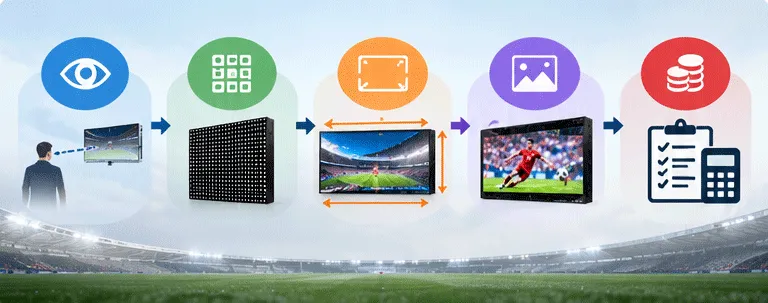
Viewing Distance → Pixel Pitch → Screen Area → Required Resolution → Project Cost
Finding the Right Balance Between Resolution and Viewing Distance
The purpose of pixel pitch optimization is to match technical resolution with human visual perception.A smaller pitch gives the display more pixels. That is useful when the audience can get close enough to see the difference.A larger pitch reduces pixel density. That can be appropriate when the screen is large and viewers remain far away.
For example, P6 LED display, P8 LED display and P10 LED display should not be treated simply as three levels of image quality. They represent different balances between pixel density, viewing distance, screen area and project cost.
For projects comparing different LED screen specifications, the useful comparison is therefore not simply the smallest available pixel pitch. It is the relationship between the pitch and the actual viewing environment.
For a large outdoor stadium, the selection process can be summarized as:
Closer audience → finer pixel pitchLarger viewing distance → larger pixel pitch can be consideredLarger screen area → greater cost impact from finer pixel pitch
The right LED screen resolution is ultimately the resolution that provides sufficient visible detail for the intended audience without adding large amounts of pixel density that the viewing environment cannot effectively use.
Every stadium project has different viewing distances, screen dimensions and content requirements. If you are planning a stadium LED screen or outdoor LED display, share your screen size, viewing distance and application with our team. We can help evaluate the appropriate pixel pitch and display configuration for your project.
Contact Us to discuss your project requirements and get a configuration recommendation.

Recent Posts






Contact US
Product Information
Quantity
Unit
Piece
Support order samples, customization, wholesale direct, and complete payment. If the product you look for does not have corresponding customized content, pls fill out the form below to contact us, and we will reply ASAP.