

.jpg?x-oss-process=image/resize,w_100/quality,q_100)
.jpg?x-oss-process=image/resize,w_100/quality,q_100)
.jpg?x-oss-process=image/resize,w_100/quality,q_100)
From Glass Facade to Dynamic Media: How High-Transparency LED Is Used in High-Rise Buildings
Oct 03, 2026
A high-rise commercial complex in a major city had already established a strong architectural presence through its glass curtain wall. During the day, the facade relied on natural light, reflections, and the transparency of the glazing to create its visual character. At night, however, the building had relatively limited ways to communicate with the surrounding streets and public plaza.
The owner wanted to make better use of this large facade. Brand advertising, shopping mall campaigns, seasonal promotions, and event content could all benefit from a highly visible media surface, but installing a conventional LED wall would change the appearance of the glass building itself.
The owner therefore needed a display solution that could remain visually integrated with the architecture during the day while supporting dynamic commercial content at night. This became the starting point for evaluating a transparent LED display for the building.
Why High-Transparency LED Was Considered for the Facade
Architectural lighting has long been used to create nighttime identities for high-rise buildings. Floodlights, linear LEDs, and point-light systems can emphasize building outlines, structural details, and changing colors without covering the facade with a display.The requirement in this case was different. The owner wanted to run actual visual content rather than simply illuminate the building.
A conventional LED display could provide the required content, but placing a solid display across a large glass facade would introduce another issue. The screen could become visually dominant during the day, reducing the openness of the curtain wall and changing the appearance of the building.
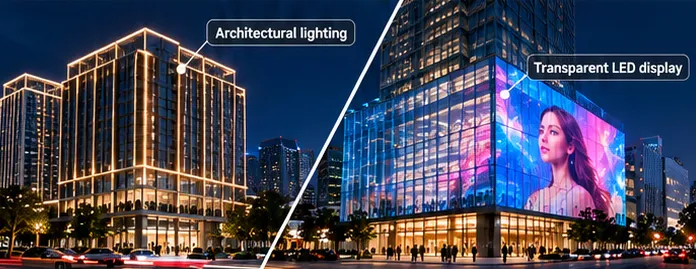
A high-transparency LED system provided another way to approach the project. By placing the display behind the glass, the system could support dynamic content while allowing the facade itself to remain visually open. This made a glass curtain wall LED display a practical direction for a project where both commercial media use and architectural appearance needed to be considered.
That was the direction the project team took.
Choosing P7.81 Around the Building and Its Viewers
The display was planned for a large section of the main facade facing a major road and public plaza. The main viewing distances were expected to fall between roughly 20 and 80 meters, with pedestrians seeing parts of the display from around 10 to 30 meters and more distant viewers watching from the plaza and surrounding buildings.These conditions were considered together when selecting the pixel pitch.
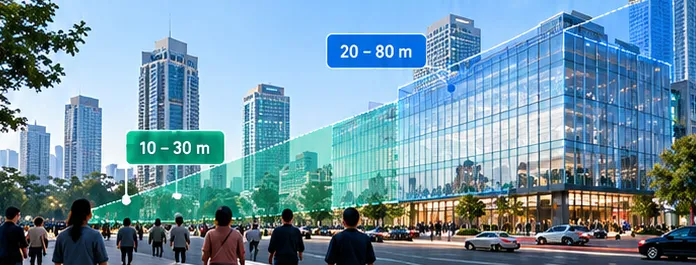
The project did not require the same pixel density as an indoor screen designed to be viewed from only a few meters away. At the same time, the display still needed to present advertising, branded graphics, and moving content clearly enough for people approaching the building.After evaluating the viewing distances together with the facade area and transparency requirement, we selected P7.81 transparent LED as the main configuration for the project.
The selected window glass transparent LED screen uses a 7.81 × 7.81 mm pixel pitch and provides approximately 55% permeability, with brightness up to 4,000 cd/m² and a refresh rate of 1920–3840 Hz. Its lightweight cabinet options were also suitable for a large-area installation behind an existing curtain wall.The transparency was particularly important because the display would remain behind the glass during the daytime. The open LED structure allowed the glazing, interior space, and reflections of the building to remain visible instead of presenting a continuous opaque surface.
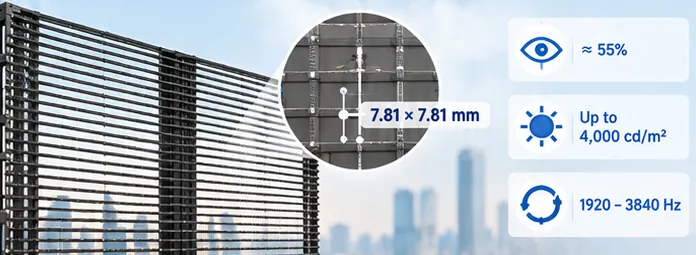
For areas with shorter viewing distances, a finer pixel pitch could be considered, but P7.81 provided the main balance required across the larger facade.
Installing Transparent LED Behind the Glass Curtain Wall
The screen was installed on the interior side of the glass curtain wall rather than changing the exterior facade.
For a high-rise building, the installation needed to work with the existing curtain-wall structure instead of introducing a separate exterior display system. Wind exposure, structural load, cable routing, installation access, and future maintenance all had to be considered as part of the installation plan.
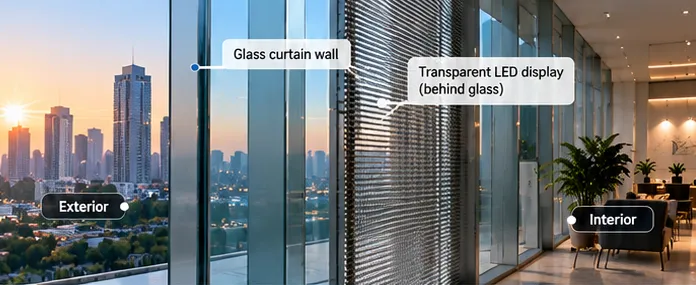
The project therefore used lightweight LED modules with a customized aluminum profile and hanging/support structure connected to the existing curtain-wall framing. Where site conditions required additional support, the structure could be locally reinforced.
Installing the display inside the glass also meant that the original exterior glazing and waterproofing system did not need to become part of the LED installation itself.
The support structure was arranged around the existing curtain-wall system, while the LED modules and associated cabling were positioned so that technicians could access the system from the interior side for future maintenance.
For project teams comparing a transparent LED facade with conventional LED cabinets, this installation approach also changes how the display needs to be coordinated with the building. The LED system is planned around the existing facade rather than requiring the exterior envelope to be rebuilt around the display.
Using the Glass Facade as a Dynamic Media Surface
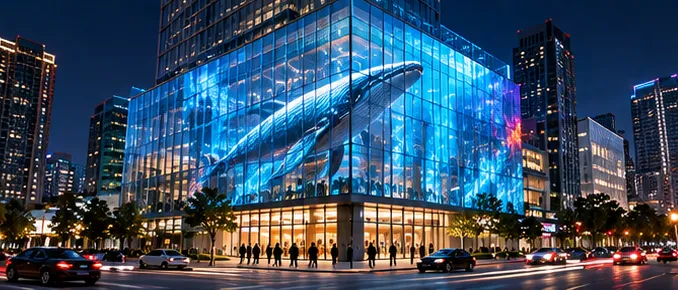
Once the system was commissioned, the same section of facade could serve different purposes during the day and at night.During daylight hours, the transparent LED display remained behind the glass and blended into the facade, allowing the building to retain its original visual character.
After dark, the owner could use the display for brand advertising, shopping mall promotions, seasonal campaigns, event announcements, and dynamic visual content. The facade could therefore continue to function as part of the building's architectural envelope during the day while becoming an active media surface after sunset.For the owner, this created a way to use an existing architectural surface for ongoing digital communication rather than relying only on static facade lighting. The P7.81 transparent LED helped the owner maintain the architectural character of the glass facade during the day while using the same facade for dynamic commercial content at night.The owner was satisfied with the transparency and the way the display integrated with the building after installation. The system continues to support the property's ongoing media use.
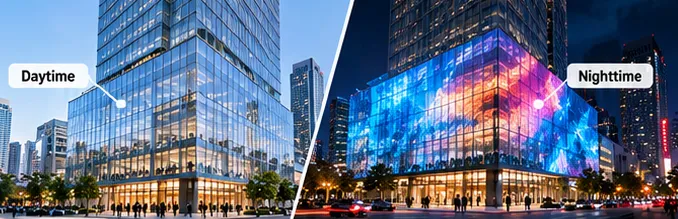
For similar projects, the same selection process can begin with the building itself: viewing distance, curtain-wall structure, required transparency, installation conditions, maintenance access, and the type of content the display needs to carry.
If you are planning a high-transparency LED project for a high-rise glass facade, Our team can work with your project team on product selection and installation planning, helping evaluate the suitable pixel pitch, display configuration, and integration approach for the building.

Recent Posts

October 26, 2016
The Most Successful Engineering Contractor
Jul 10, 2023
Shipping
Jul 10, 2023
Training camp in September 2021
Jul 10, 2023
September 2022 PK match
Jul 10, 2023
September 2022 kick-off meeting
Jul 10, 2023
January 2023 Annual MeetingContact US
Product Information
Quantity
Unit
Piece
Support order samples, customization, wholesale direct, and complete payment. If the product you look for does not have corresponding customized content, pls fill out the form below to contact us, and we will reply ASAP.